
Doctrine vs action; the myth of 'just reconnaissance'
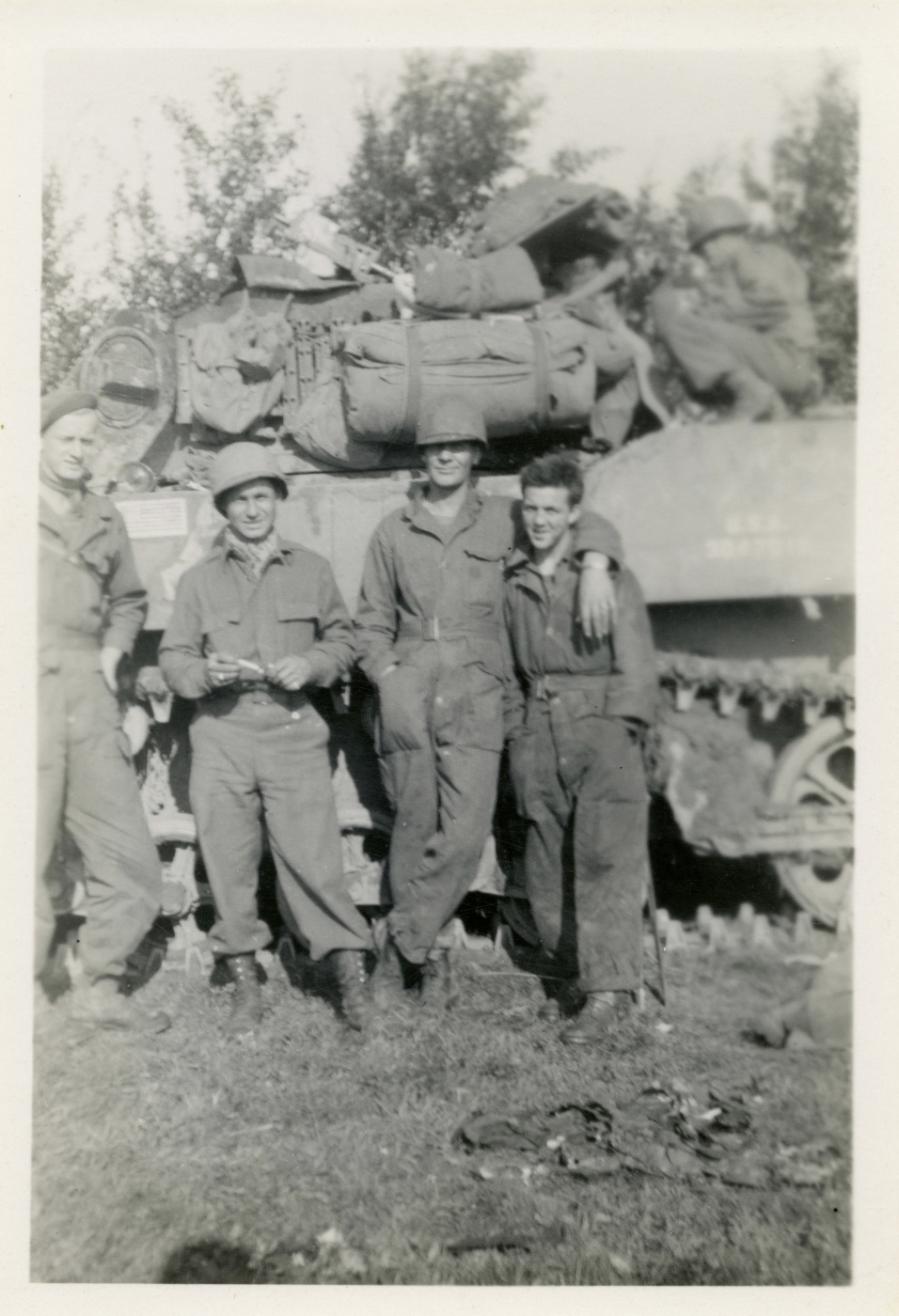
From the collection of Tank Company F commander Capt. Elliott Averett Jr. Original caption details: Trogovich, Nowacki, Elvestrom, Wuelke. Mürringen, Belgium. Sept 44. (Nowacki is currently tentatively identified as Sgt Sylvester G. Nowacki 35162842)
The 24th Cav Recon is typecast as a forward reconnaissance unit. It's natural that non-experts would think this. "Reconnaissance Squadron" is in the name. But it's misleading because pure reconnaissance in the way that most of us might imagine it was rare in 1944/45. As William Nance writes in 'Sabres Through The Reich':
““...nearly every action the cavalry undertook against the enemy could be considered either offensive or defensive combat.””
[William Stuart Nance, Sabers through the Reich: World War II Corps Cavalry from Normandy to the Elbe (Lexington: University Press of Kentucky, 2019), 266.]
After the war, in an academic Masters thesis, Capt. John Tully argued that less than 4% of the Fourth Cavalry Group's time was spent on recon. As grandson of Fourth Cavalry Group commander Col. Joseph Tully and nephew of 24th Cav Recon Executive Officer, Major Harry A. Clark Jr, Capt. Tully spoke with authority.
His thesis focuses on the chasm between mechanized cavalry doctrine and the realities of their use by Corps commanders.
Take Operation Cobra - the famous 'Normandy breakout'. In this pivotal moment of the war, in July 1944, the 24th Cav Recon was integrated into tank-heavy task forces under the 2nd Armored Division. Rather than conducting distant reconnaissance it seized terrain, established blocking positions, repelled counterattacks and operated as a combined-arms manoeuvre element. It fought attached to or alongside tank, engineer and artillery units in direct offensive operations.
Throughout the pursuit across France, the squadron reconnoitred river crossings, secured bridges, screened flanks and reduced enemy strongpoints. Information on the disposition of the enemy was rarely obtained without combat. Reconnaissance was indistinguishable from fighting for ground.
What they were designed and equipped for and what they really had to do were often different.
Tully says that, in contrast to entering Europe under a doctrine of reconnaissance divorced from combat:
““The combat record revealed that the group performed almost the full range of ground combat missions. Of note, many of the missions were doctrinally considered horse cavalry missions. In addition, the group did not operate exclusively as a corps asset and did not perform distant reconnaissance as envisioned in pre-war doctrine. Also, the group executed extensive dismounted operations (both offensive and defensive), a particularly poor use of a mechanized cavalry unit. Finally, the group was frequently used to bolster the combat power of infantry divisions. Unfortunately, the group’s last wartime commander felt the group was shamelessly neglected when operating attached to infantry divisions.””
[John N. Tully, Doctrine, Organization and Employment of the 4th Cavalry Group during World War II (MMAS thesis, U.S. Army Command and General Staff College, Fort Leavenworth, KS, 1994), 115, Defense Technical Information Center (DTIC), ADA284558, https://apps.dtic.mil/sti/trecms/pdf/ADA284558.pdf.]
That view is shared in a monograph, also written after the war, by Maj. Brooks O. Norman, who had served as commander of reconnaissance Troop A in the 24th Cav Recon. Norman's study focused on the actions of the 4th Cavalry Reconnaissance Squadron alone and concluded:
““Day by day it had become more apparent to all members of the squadron that the concept of reconnaissance by the “sneak and peek” method was a false doctrine. It became clear that if the squadron was to gather information and carry out its other missions it was going to have to fight. This was contrary to many of the basic principles and training of the unit and it is a compliment to the officers and men of the squadron that they were able to adjust themselves rapidly and effectively.”
”
[Brooks O. Norman, Mechanized Reconnaissance from D-Day to St. Lo, Military Monograph, Advanced Officers Class no. 2 (Fort Knox, KY: The Armored School, 7 March 1948), 17, U.S. Army Armor School Library, https://mcoecbamcoepwprd01.blob.core.usgovcloudapi.net/library/Armorpapers/ASTUP/M-R/NormanBrooks%20O.%20MAJ.pdf.]
Time and again the point is made that reconnaissance, in the sense that most of us understand it, was not the job of the 24th Cav Recon. Again, this comment in a Cavalry Journal feature from January/February 1945, describing the campaign on the Cotentin peninsula just a few days after arriving:
““... reconnaissance had to become more and more aggressive, and strong points had to be reduced instead of merely reported and by-passed. In fact, by-passing would have been impractical, if not impossible, because of the terrain and the extension of enemy installations.””
[“In Capture of Bourge de Lestre: ‘Y’ Reconnaissance Squadron in Cherbourg Campaign,” The Cavalry Journal, January–February 1945, 15.]
(Editor’s note: names of units and even personnel were sometimes changed in articles published while hostilities were continuing. In the article cited above ‘Y’ substitutes for 24th Cav Recon)
The squadron's After Action Reports make it clear that the job was mostly combat and rarely 'sneak and peak' intelligence gathering.
For many years after the war, professional military scholars analysed the gap between doctrine and the experience of units like the 24th Cav Recon in Europe.
Another example, from the early 80s.
“The latter campaigns of World War II demonstrated more basic doctrinal faults. Combat in Northwest Europe required cavalry reconnaissance units to do much more than reconnaissance. Cavalry performed the traditional roles of horse cavalry: defend and delay, exploit, attack, as well as reconnaissance. They revalidated the early findings that reconnaissance required fighting. Finally, the operation of multiple corps and field armies highlighted the unusual effectiveness of mechanized cavalry, and the critical requirement for corps cavalry to perform economy of force operations as a part of operational maneuver.
Thus, the closing battles of World War II saw the cavalry reconnaissance units fighting the traditional missions of cavalry, but hampered by a doctrine, organization, and equipment designed primarily for reconnaissance.”
[Louis A. DiMarco, The U.S. Army’s Mechanized Cavalry Doctrine in World War II (MMAS thesis, U.S. Army Command and General Staff College, Fort Leavenworth, KS, 1995), 12, Defense Technical Information Center (DTIC), ADA299016, https://apps.dtic.mil/sti/tr/pdf/ADA299016.pdf.]
The debate over lessons learned in WW2 by mechanized cavalry reconnaissance continued into and beyond the Iraq war.
““In Normandy, the compartmentalization of maneuver corridors often forced aggressive reconnaissance efforts into deliberate attacks. The old doctrinal presumptions that cavalry units could bypass strong points proved impracticable, when faced with the reality of restricted terrain and a well prepared enemy. Within the first month of operations in Normandy, cavalry units found themselves executing offensive missions to seize terrain and then hold it against repeated German counterattacks.””
[Matthew A. Dooley, Ignoring History: The Flawed Effort to Divorce Reconnaissance from Security in Modern Cavalry Transformation (MMAS thesis, U.S. Army Command and General Staff College, Fort Leavenworth, KS, 2006), 37, Defense Technical Information Center (DTIC), ADA463816, https://apps.dtic.mil/sti/tr/pdf/ADA463816.pdf.]
Although this site is not intended as a technical military history, these are important facets to the squadron's story. By appreciating the wider context - such as the gap between theory and practice - we can better recognise the extraordinary achievements of the mechanized cavalry reconnaissance units in WW2. The 24th Cavalry Reconnaissance Squadron arguably achieved what it did despite rather than because of the way it was equipped and organised.